

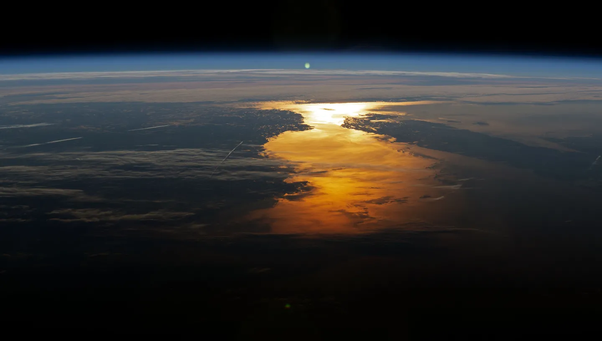
In 100 trillion years, the universe will be in the Degenerate Era, and the night sky will be dark almost everywhere.
10 to 100 trillion years is the estimated upper limit of the Stelliferous Era we are in now. Although some galaxies already ran out of gas for star formation when the universe was much younger than it is now, in the Milky Way, 1 to 2 solar masses of stars each year still form now. This can correspond to as many as 10 stars per year, as the least massive ones can have 8% of the Sun’s mass.
In 100 trillion years, the universe will run out of gas and dust for star formation, and the least massive stars that formed when the universe was young will by then transform into white dwarfs; most will no longer shine.
Our Milkymeda galaxy, which formed when the universe was young from the collision of the Milky Way and Andromeda, might contain between 1 and 2 trillion mostly dead stars. If someone were standing on a planet orbiting an average dead star and looked in the sky, they would see only a small number of shiny points.
They would be white dwarfs, which would still shine with energy stored from when their progenitor star carried out nuclear fusion. An infrared telescope would reveal a sky rich in stars invisible to the naked eye. They would be white dwarfs that are not cold enough yet to be black dwarfs but are already invisible in the visible light spectrum.
Because the universe is accelerating its expansion, the Milkymeda galaxy will be enclosed in its own visible universe, and all satellite galaxies will be absorbed by then. This means no other galaxies would be visible in the sky, like the Large Magellanic Cloud or Andromeda, which we can see with the naked eye today.
Since most stars will be dead by then, there will be no comets. Some icy rocks will still perform elliptical orbits around these dead stars, but they will never gain comas since there will be no heat to melt their ices.
Rare real stars will still exist here and there. They will form via collision of cold white dwarfs or brown dwarfs. These systems will be similar to ordinary star systems we are familiar with now, but the average heavier elemental content will be higher by then. It might enable the existence of cold stars. At very high heavier elemental content, stars will be able to carry out nuclear fusion of hydrogen with only one proton at lower masses. Currently, they need to be at least 8% of the Sun’s mass. Such low-mass, cold stars will again not be bright. Instead, they will have icy clouds.
The Degenerate Era will be much longer than the Stelliferous Era. If protons decay, the Degenerate Era will be cut short to at least 10^33 years. In 2025, a research paper proposed that all massive objects in the universe might emit Hawking Radiation-like radiation and evaporate.
If this proves true, the universe might enter the Black Hole Era earlier than previously believed, in 10^78 years, as all massive objects disappear, leaving only black holes. Over these eons, the last shiny dots, the last remaining stars emitting visible light in the sky, will disappear until there are none.